
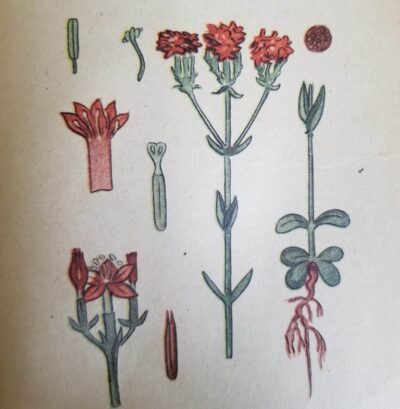
Georgia’s plant cover is rich and diverse. Many plants found in our country are used for medicinal purposes. In this regard, many plants remain only partially studied or have not been studied at all. Increasing the resources of medicinal plant raw materials relies on the scientific study of empirically gained knowledge accumulated from the distant past.
A plant, which serves as a source for the formation of organic substances, holds great significance. It carries out this process with the help of the energy of sunlight and the chlorophyll granules present in its tissues. The plant decomposes carbon dioxide present in the air and uses the released carbon to produce organic substances. Organic substances always contain carbon, and animals, including humans, utilize the organic compounds produced by plants—both directly and indirectly—to meet the needs essential for their existence.
Since time immemorial, humans have used plants for a wide range of needs. Plants were also widely employed as medicinal remedies. Through observations made in the process of working with and interacting with nature, humans developed an understanding of the positive or negative effects of different plants on the body. Peoples living in completely distant regions considered the same plant—or parts of it—to have similar effects. This common understanding is rooted in the conditions of labor, daily life, and interaction with nature.
Through the process of labor and the use of plants, humans discovered their beneficial properties and eventually began to cultivate them artificially. This occurred with wheat and a number of other food plants, as well as with medicinal plants. Since time immemorial, humans have paid close attention to the useful properties of plants. This was driven by the need to satisfy essential requirements for survival and was inseparably linked to labor. Gathering wild fruits, digging up roots, and similar activities represented the first stages in the development of humans’ study and understanding of the plant world.
The origins of plant cultivation and use date back to the distant past. Around 3000–4000 BCE in ancient Egypt, cultivated plants were already in existence: emmer wheat, barley, celery, lentils, chickpeas, flax, lupine, poppy, grapevine, palms, tamarind, olive, papyrus, and many others. Naturally, these plants were also used for medicinal purposes. Various written records attest that medicinal plants were well known in Egypt. Special attention was given to poppy (used as a sleep aid), peppermint, papyrus, and centaury.
Narcotic plants were also widely used, including opium, mandrake root and fruit, Indian hemp, and hashish derived from it, among others.
It is noteworthy that the cultivation of medicinal plant gardens has a long history in Georgia.
According to the knowledge presented in Argonautica, the medicinal use of plants was widely practiced in Colchis. Hecate, who was renowned for her knowledge and use of the healing properties of plants, had a specially cultivated garden of medicinal plants. This legend indicates that in ancient Colchis, medicinal plants were deliberately cultivated.
In Georgia, the medicinal use of plants dates back to time immemorial. For example, chickpeas were used against colds, fever, and heart palpitations; fritillaria was applied for toothache; lavender was used to treat abscesses, and so on. In addition, fruits of plants imported from warmer countries—such as iles—were employed in Georgian medicine to reduce fevers and for other purposes.
The legend “About the Argonauts” is also interesting because it highlights the role of women in medicine, specifically in the preparation of remedies and the use of plants for medicinal purposes. Women were believed to have played a major role in healing with plants. In the myths of various countries, women are mentioned as healers: for example, Polydamna, described as “most powerful,” in Egypt; Agamede, the “golden-haired,” in Greece; and the “wise” Kaza in Bohemia. These women lived after the era of matriarchy.
In folk epics, their role in healing and caring for people is frequently emphasized. It is also noteworthy that some plant names are associated with the names of goddesses—for example, Artemis giving rise to Artemisia, among others.
With the development of scientific fields, by the 16th century the study of the chemical composition of plants had emerged as an important subject of inquiry.
Since the 19th century, various substances have been discovered in plant tissues. The development of chemistry made it possible to detect certain substances using specialized reactions. For example, when studying the structure of the walls of an orange fruit, it becomes clear after three different treatments of its tissues that the essential oil droplets take on a reddish-orange color. Iodine can be used to detect starch in plant tissues, among other applications.
The Georgian people have a very rich and centuries-long experience in the medicinal use of plants, as attested by numerous sources, including ancient Georgian medical texts. Of particular interest are the old Georgian medical manuscripts, such as the “Usuro Karabadini”, which dates back to the 9th century, the 12th-century medical text “Ts’igni Saak’imoi”, and the 15th-century “Karabadini”.
An invaluable source for identifying the names of medicinal plants used in ancient Georgia is Sulkhan-Saba Orbeliani’s “Sitkvis Kona” (“The Treasury of the Word”). Additionally, the manuscript lexicons compiled by Ioane and Teimuraz Bagrationi list many medicinal plants with their old Georgian and Latin names. Ioane Bagrationi was both a practicing physician and a naturalist, and it is clear that he was interested in medicinal plants from Georgia as well as from other countries.
There are also works by other researchers and travelers that provide insight into the medicinal plants used in ancient Georgia. Among these plants, representatives of many different botanical families are found, with particular prevalence of legumes, crucifers, Rosaceae, Lamiaceae, ferns, Asteraceae, Poaceae, Brassicaceae, and Apiaceae.
When humans gradually began to use plants empirically for medicinal purposes over the course of historical development and in the process of their daily life and activities, they, of course, had no knowledge of the substances contained in plants that produced desirable or undesirable effects on the human body. Today, plant-derived substances with medicinal properties are known. Among carbohydrates, starch is widely distributed in the plant world and represents a product of assimilation. In plant cells, starch appears in the form of concentric or eccentric granules, or as groups of granules.
Among plants rich in starch, cereals are particularly noteworthy. These are frequently mentioned in ancient Georgian medicine and include rice, barley, wheat, millet, and others. All of these plants served both as food and as medicinal resources. In Georgia, rice cultivation is possible in lowland areas, particularly in western regions of the country. The medicinal use of rice grains was primarily astringent in nature. Rice was given to patients during severe bloody diarrhea. Rice starch is very gentle and is still used today in starch-based poultices, ointments, and as a thickening agent.
The use of barley and wheat in Georgia has an ancient history. Archaeological excavations confirm that barley and wheat were known in prehistoric times. They also have a long history of medicinal use. Ointments made by mixing flour from barley and wheat were employed to treat various ailments.
Another cereal plant, Vazits’vera, is no longer used in medicine today. In the past, however, this cereal was part of remedies used for severe gastrointestinal disorders and bloody vomiting.
Among plant-derived substances used for medicinal purposes, glycosides are particularly noteworthy. These are bitter compounds. Plants containing glycosides also include enzymes that facilitate the hydrolytic breakdown of glycosides, although some glycosides are toxic. Glycosides are classified according to their chemical composition. Certain glycosides are characteristic of particular botanical families; for example, plants of the Brassicaceae (cabbage) family contain sulfur-containing glycosides.
Historically, the following representatives of this botanical family were used medicinally: beetroot, radish, cabbage, mustard, pepperwort, and watercress. Among them, mustard is the most significant in terms of glycoside content. In ancient Georgian medical sources, mustard is also referred to by the names k’ok’i and t’ara. Mustard seeds were used as a pain reliever, and even today mustard paste and a solution of mustard essential oil in alcohol are used as an emollient.
For plants of the Rosaceae family, the glycoside amygdalin is characteristic and is found in many of its representatives.
Representatives of the Rosaceae family include: apricot, peach, cherry, apple, strawberry, blackberry, almond, quince, hawthorn, medlar, pear, and serviceberry. Apricot, in particular, is very rich in vitamin C and belongs to the group of plants containing this vitamin.
There are plants that contain cardiac glycosides used for heart treatment. Most of these plants are toxic due to the poisonous nature of the glycosides they contain, but in small doses they are used to treat heart diseases.
In Georgia, there are also plants whose composition includes glycosides acting on the gastrointestinal tract, such as aloe, senna, and rhubarb. In ancient Georgian medical sources, aloe is referred to as sabri. Sabri is a plant characteristic of tropical and subtropical regions. In Georgia, it grows well along the Black Sea coast. Historically, sabri was used to relieve headaches, heal wounds, and treat lung diseases. It was also widely used to treat gastrointestinal disorders.
Ancient Georgian medicinal plant materials also include plants containing alkaloids. Alkaloids are found in various organs of the plant. Over 700 plants are known to contain different alkaloids. These substances are physiologically highly active and are widely used in medicine. They have a bitter taste and contain nitrogen. They exhibit basic reactions and form salts when interacting with acids. The first alkaloid isolated, 150 years ago, from opium was morphine. Today, the number of known alkaloids exceeds 800. Among them are atropine, cocaine, strychnine, quinine, platiphylline, salsoline, ephedrine, and others.
Among the medicinal plants used in ancient Georgian medicine, many contained alkaloids and were widely employed to treat various diseases. Such plants include: shkhama, sea holly, boxwood, pomegranate, thermis, kots’akhuri, narcissus, poppy, and others. Shkhama was also called abutarleti and was used as a painkiller. In addition, it was employed as a snuff to relieve severe nasal congestion or, in some cases, to revive an unconscious person. For this purpose, a complex powdered mixture was applied in the nose, which included shkhama, boxwood, safflower, and other ingredients.
Fennel and basil were widely used. They were primarily known as diuretics. Fennel was also included in sedative preparations. Basil was valued for its diuretic, eye-healing, and other medicinal properties.
Mint was also widely used and had been employed since ancient times. It was regarded as a versatile medicinal plant with multiple therapeutic effects.
Among essential oil–containing plants, katabalakha (also called valerian) is noteworthy. Preparations made from it were considered cardiac remedies.
Essential oil plants were used both internally, in treatments for heart, lung, liver, and gastrointestinal disorders, and externally, in poultices, as emollients, or in aromatic baths. Among these plants, urtsi stood out for its multifaceted use. It was employed as an expectorant, included in complex medicinal formulations whose vapors were inhaled by patients, and used to relieve severe sore throats. For kidney pain, hot poultices made from urtsi were applied. Even today, this plant continues to be used as an expectorant and in aromatic baths.
In addition, ancient medicine also employed essential oil–containing plants from other botanical families. Examples include absinthe, tarragon, bay, hyacinth, clove, narcissus, sandalwood, lavender, and others.
Oils extracted from these plants, as well as various parts of the plants themselves, were used to treat different ailments. For instance, olive fruit, cured in salt, was considered a remedy for toothache.
Olive leaf baths were administered to patients with gastrointestinal disorders. Another important oil-bearing plant is tk’ipa-lobio, which is also mentioned in ancient Georgian medical texts under the name Abusalatini. Oil extracted from its seeds was regarded as a therapeutic agent.
Camphor tree was considered a highly significant oil-bearing plant. Its oil was used to treat nervous disorders and was also applied to prevent burns.
In ancient Georgian medicine, besides their use as remedies, some medicinal plants were employed for other purposes. Examples include celery, laurel, wild parsley, beetroot, oregano, and barley.
Celery, in particular, was a versatile and noteworthy plant. For some patients, garments made from celery fibers were worn. Celery fibers were also used to cover containers for medicinal preparations. Additionally, celery fibers were soaked in remedies and applied as compresses.
Fig sap from fig trees and mulberry gum were used to extract damaged teeth.
Georgia is rich in many beneficial and medicinal plants. The use of these plants has a long-standing tradition, as evidenced by Georgian folk medicine. Most of the medicinal plants used in Georgia grew locally, although some were imported from other countries. Some plants adapted so well to Georgia’s natural conditions that they were able to grow successfully in the wild.
Sources:
Medicinal Plants of Georgia: (Primarily Medicinal Plants Used in Ancient Georgia) – N. Tsutsunava
Medicinal Plants of Georgia and Their Uses – Svetlana Chagelishvili, Mezevinar Gogorishvili
Medicinal Plants – Aslan Inashvili
Translated from Georgian by Elene Shengelia.