
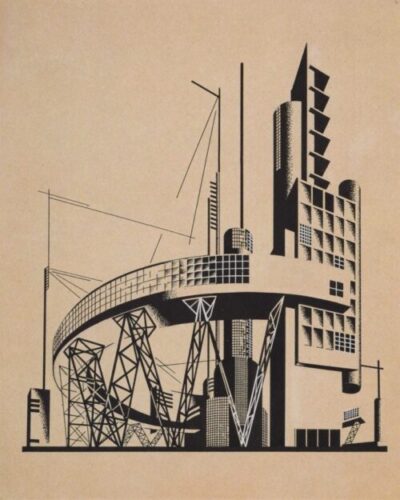
The primary task of modern art is to ensure that the content of art arises from reality and is given a rational direction. The formulation of these tasks and their resolution should be regarded as a great achievement of modern art. A proper understanding of the content of art tells us that art cannot become reality if it does not depict actuality, if it does not correspond to the needs of contemporary life. Forms of art that exist in isolation do not constitute a significant factor. Art must be connected to the substance of life. In this connection, art acquires the meaning of existence. The artistic form of a work and the meaning of its content create a unified whole; it is impossible to separate them from one another. If such a separation occurs, the fundamental integrity of art’s existence is essentially violated, and its foundation collapses.
Examples of the disruption of the fundamental element of art can be found everywhere in abundance. It is unfortunate, however, that among us this phenomenon has taken on a systematic character. Therefore, measures must be taken immediately to restore the authenticity of art.
This distorted phenomenon has taken on a particularly harmful character in the field of architectural construction in our art. In the city of Tiflis and in several other cities, a number of buildings of public importance have been constructed, for example the Tramway Workers’ House, the façade of the Museum of Georgia, the building of Sakkinmretsvi, the railway station of the city of Gori, and others.
On the one hand, these buildings were meant to serve important public needs; on the other hand, they were expected to contribute to the proper development and improvement of the city.
The architectural construction and decoration of these buildings were to be based on the resolution adopted by the City Executive Committee in 1924, according to which all public buildings were to be constructed in the Georgian style. However, as it appears, the issue of the Georgian style proved to be highly misunderstood, and the architectural style of our past was recognized as an indispensable element of contemporary architecture.
In the buildings already constructed, the so-called Georgian style is reflected in the direct and illogical imitation of the external ornamentation of old ecclesiastical and secular architecture. The outward decoration of church walls, arches, narrow windows, and columns have been transferred without consideration.
No account has been taken of the requirements of present-day buildings. On the contrary, the entire internal and external construction of a building becomes a sacrifice to outward ornamentation, whereas ornamentation ought to be only the logical result of the inner structure.
For this very reason, we see that the constructed buildings fail to fulfill their purpose: residential buildings are not suited to proper living conditions, public buildings do not satisfy public needs, and the overall appearance of the city streets is unsatisfactory.
The construction of buildings of this architectural character is justified in the name of preserving a national style. Yet the disastrous result we are witnessing stems precisely from a mistaken understanding of what contemporary national art should be.
Some believe that our present-day art ought to consist in the direct restoration of old forms. This idea has taken deep root among us. Certain individuals place no faith in free interpretation and regard mere imitation of old forms as the true task of modern art.
We have repeatedly pointed out the groundlessness of this view, and the buildings that have been constructed stand as the clearest example of its inadequacy. It is deeply regrettable that so much material wealth has been spent not on the city’s well-being, but on its disfigurement. In the process, our national creativity has been entirely negated.
This period of construction must be regarded as a harmful phenomenon in the history of our art.
When speaking of the architectural style of our past, we should have in mind the finest forms of a particular epoch of our art. Yet we must remember that these forms belong to the best examples precisely because their organization was connected with the very idea and purpose of construction; they logically expressed architectural content.
At the same time, these forms emerged under the influence of the original life of our people, the specific character of our nature and building materials, and through an original interpretation of those artistic forms that affected us. On this foundation, the systematic development and transformation of artistic forms gave us the architectural images of which our art can be proud.
Our contemporary architecture must be created under the influence of new life and new conditions. First of all, we must remember that architecture represents the logical construction of internal volume. It must fully satisfy the functional requirements of the building.
The external appearance should logically derive from the internal structure. The solidity of the volume, at the same time, must correspond to its harmonious articulation. Any ornamentation should be justified solely by its organic purpose.
It must be firmly established that architecture is reflected not in ornamental decoration, but in the building’s overall volume and construction. The forms of the volume should arise from the functional purpose of the structure, from the building materials, and at the same time be adapted to the conditions of our natural environment.
The use of architectural forms from our past should occur only for practical purposes and through free interpretation. Finally, through the harmonious arrangement of forms, we achieve a unified work that is satisfactory both from a local artistic perspective and in terms of its direct functional use.
Author: Davit Kakabadze
Year: 1928
Translated from Georgian by Elene Shengelia.